Tokenised Deposits Explained: How the Money Moves
Every bank seems to have a tokenised deposit announcement this autumn. Wells Fargo is launching one for corporate clients. Seven UK banks just completed their first live customer transactions. JPMorgan already runs one on a public blockchain for institutional clients.
Most of the coverage explains why it matters. Very little explains what it actually is.
So here is the plain version, with a diagram of where the money goes.
Your bank balance, in a different format
Your balance at a bank is not money sitting in a vault. It is a promise: the bank owes you that amount. On the bank’s balance sheet, it is a liability.
A tokenised deposit is the same promise, recorded on a blockchain ledger instead of the bank’s core banking system. Same bank, same liability, same currency. Wells Fargo calls it a representation of commercial bank money on a blockchain.
Nothing new gets created. When you convert €1m, your ordinary balance goes down by €1m and you receive 1m tokens. Same euro, different ledger.
That is also why Wells Fargo says its tokens carry the same regulatory protections and deposit insurance eligibility as its ordinary deposits.
Not a stablecoin
This is where most of the confusion sits.
A stablecoin is usually issued by a company that is not a bank. You hold a claim on a pool of reserve assets, typically cash and short term government debt. In most cases there is no deposit insurance and no interest.
A tokenised deposit is issued by your bank. It is a claim on the bank itself, exactly like your current account, and it can pay interest. JPMorgan positions its USD deposit token, JPMD, exactly this way: backed by the bank’s balance sheet, interest bearing, and only for approved institutional clients.
A stablecoin is new money from a new issuer. A tokenised deposit is old money on new rails.
How the money actually moves
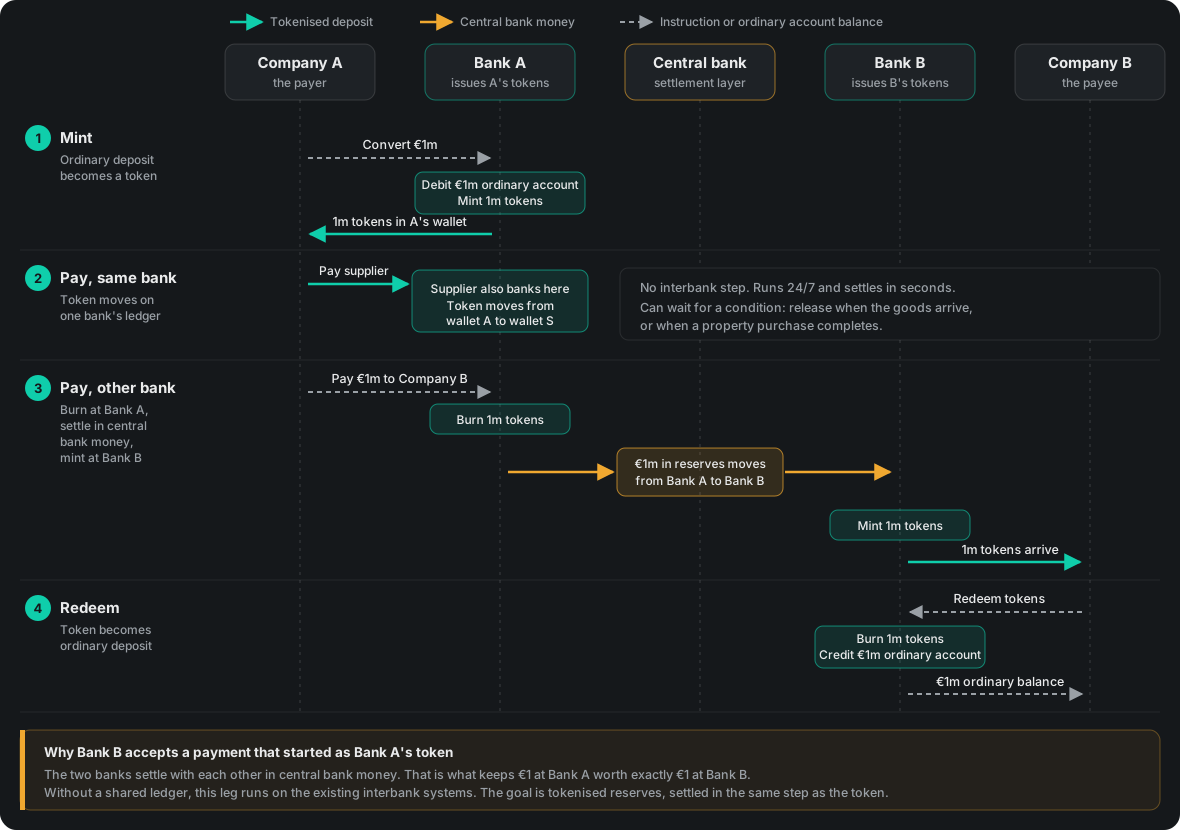
Four steps. Here is what happens in each one.
1. Mint. You ask Bank A to convert €1m. The bank debits your ordinary account and issues 1m tokens to your wallet on its ledger. Only approved clients get a wallet. This is not a token anyone can buy.
2. Pay someone at the same bank. If your supplier also banks with Bank A, the token simply moves from your wallet to theirs. No cut off times, no batches, 24/7.
The payment can also wait for a condition. That is exactly what the UK pilot tested on two remortgages: the funds were locked, then released automatically at completion.
3. Pay someone at another bank. This is the step most articles skip.
Bank B has no reason to hold a promise from Bank A. So Bank A burns your tokens, pays Bank B in central bank money, and Bank B mints new tokens for Company B.
Central bank money is the one asset every bank accepts from every other bank without questions. A BIS deputy general manager called it the trust anchor in September. It is what keeps €1 at Bank A worth exactly €1 at Bank B, which central bankers call the singleness of money.
Without a shared ledger, this leg is an ordinary interbank payment, with ordinary operating hours. The ambition is to settle it in tokenised central bank reserves, in the same step as the token transfer, so nothing can happen halfway. The BIS says Project Agorá has already shown this works across currencies and borders.
4. Redeem. Company B converts the tokens back. Bank B burns them and credits the ordinary account. From there it is a normal balance again.
Step 3 is where it breaks today
If every bank runs its own ledger, your tokens only work with clients of your own bank. In the same BIS remarks, tokenised deposits without interoperability were described as “walled gardens” that cannot cross a bank’s KYC boundary.
That is why shared networks matter more than single bank launches:
- UK: the Great British Tokenised Deposit initiative puts seven banks on one shared platform. Retail pilots finished in September 2026, and digital bond settlement comes next.
- US: The Clearing House and its member banks, including JPMorgan, Citi, Bank of America and Wells Fargo, plan a shared tokenised deposit network for the first half of 2027. Large multinationals are expected to be the first users.
Until those networks are live, a tokenised deposit is a very fast payment inside one bank, and a fairly normal payment everywhere else.
What I would ask my bank before any pilot
This is a treasury technology question before it is a crypto question. So the questions are the usual ones, applied to a new rail.
- Which ledger, and who else is on it? Only clients of this bank, or other banks too?
- How does a payment to another bank settle, and when? 24/7 all the way, or only until the interbank leg?
- What shows up in my statement? Do token movements appear in camt.053 or MT940, with which booking codes?
- How does my TMS or ERP see the wallet balance? A separate account, an API, or yet another portal to log into?
- Which deposit protection applies in my jurisdiction? Wells Fargo’s own release notes that deposits held in its non US branches and affiliates are not FDIC insured.
If the answer to question 3 is “we are still working on it,” you know which team will be reconciling by hand.
The short version
Tokenised deposits do not change what your money is. They change when it can move, and what it can wait for.