FREE MINI-COURSE · 9 MODULES · ADVANCED

SWIFT Corporate Connectivity Masterclass

A deep dive into SCORE, identity, messaging, architecture, ISO 20022, GPI, the blockchain ledger, and the future of cross-border payments — from the corporate treasury seat, not the bank's.

After this course, you will be able to
  • ✓ Choose between SCORE, MA-CUG, and TRCO for your own connectivity model
  • ✓ Explain the difference between a BIC and an LEI, and why both matter
  • ✓ Read an MT-to-MX mapping table and know what changes in your own files
  • ✓ Compare SWIFT, API, and host-to-host architecture on the dimensions that matter
  • ✓ Walk into 2026 with a concrete, quarter-by-quarter action plan

treasuryease.com

The promise vs the reality

11,000+
Member institutions
200+
Countries & territories
$150T+
Annual volume
46M+
Daily messages

The theory: one SWIFT connection replaces all bank channels with a single, secure, standardised window to the entire financial network. The reality is more complicated.

Five things the promise leaves out
  • 1. SWIFT connectivity is relatively expensive (EUR 2,000 fixed annual + bank charges + service bureau fees)
  • 2. Implementation is not simple and requires significant project management
  • 3. Not all banks, FIs, and dealing platforms are connected to SWIFT
  • 4. Banks use fields in SWIFT messages slightly differently, breaking the "single standard" promise
  • 5. Corporate treasury will always need other network connections alongside SWIFT

Three corporate access models

Every corporate connection to SWIFT goes through one of these three. Which one fits you depends on scale, not preference.

SCOREMA-CUGTRCO
Launched200720011998
Admin bySWIFTMember bankN/A
EligibilityFATF listed companyBank's corporate clientsTreasury confirms only
Best forGlobal corps, $25B+ revMid-size multinationalsFX/treasury confirms
ISO 20022SCORE+ / FINplusCBPR+ mandateNot applicable
FutureEvolving to SCORE+Stable, decliningLegacy
Module 1 action

Find out which model your company is actually on today — SCORE, MA-CUG, or TRCO — and whether that still matches your scale and revenue.

BIC vs LEI: the dual identity system

BIC — Business Identifier Code

8 or 11 alphanumeric chars — bank code + country + location + branch.

Purpose: routing messages on SWIFTNet. Managed by SWIFT (ISO 9362). Used in MT & MX headers, RMA.

LEI — Legal Entity Identifier

20-character alphanumeric — LOU prefix + reserved + entity-specific + checksum.

Purpose: global legal entity ID. Managed by GLEIF (ISO 17442). Used in ISO 20022, EMIR, MiFID II, SFTR.

Critical deadline: November 2026

SWIFT will no longer support unstructured addresses. Only structured or hybrid formats will be allowed — minimum: town/city name + ISO country code. This affects all parties across CBPR+ messages. Corporates using MT101 via Tag 59 must adopt Format F for structured postal address data.

Three messaging channels, three purposes

FIN — Legacy MessagingDeclining, no new features

Store-and-forward. MT format, proprietary. Network validates format only. Max 10,000 chars. MT101, MT103, MT940, MT942...

FINplus — ISO 20022 MessagingActive growth, future-proof

InterAct-based. MX/ISO 20022 XML, strict validation, full Unicode. pacs.008, pacs.009, camt.053... This is where SCORE+ moves corporates.

FileAct — Bulk File TransferStable, complementary

Any file format, real-time or store-and-forward, no message-level validation. Bulk payments, reports, BAI2 — lower per-unit cost at scale.

Module 3 action

Ask your bank which channel your actual payment initiation runs on today — FIN, FINplus, or FileAct — and which one they expect you to be on by end of 2026.

MT to MX: key message mappings

MT (legacy)MX (ISO 20022)Description
MT101pain.001Payment Initiation (Corp-to-Bank)
MT103 / STPpacs.008Customer Credit Transfer
MT202 / COVpacs.009FI-to-FI Transfer / Cover Payment
MT900 / MT910camt.054Confirmation of Debit / Credit
MT940camt.053End-of-Day Statement
MT942camt.052Intraday Statement
MT199 / 299trck.004GPI Tracking (SR2026)

Nov 2025: Coexistence ended · Jan 2026: Contingency charges start · Nov 2026: Structured address mandate · Late 2026: camt.052/053/054 rollout (JPM)

SWIFT vs API vs host-to-host

SWIFTAPIHost-to-Host
Setup costHigh ($50K–200K+)Low–MediumMedium
Bank coverage11,000+ institutionsPer-bank integrationPer-bank integration
Real-timeNear real-time (FIN)Real-timeBatch or RT
TMS/ERP integrationNative (SAP, Kyriba...)SDK/custom buildProprietary format
Best forGlobal multinationalsFintechs, instant cashRegional setups

2026–2028: SWIFT is transitioning Alliance Connect to SD-WAN, with a new Alliance Connect Virtual on-premises VPN for customer VMs.
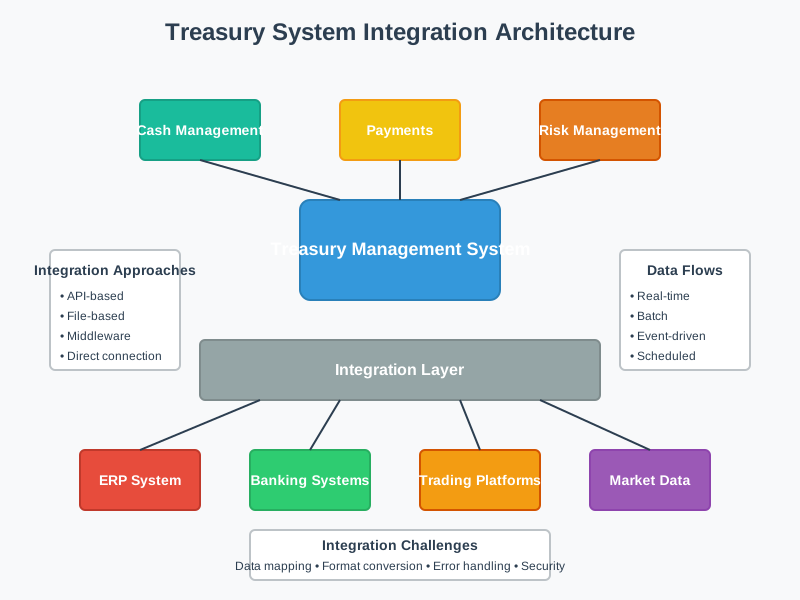
Treasury system integration architecture: TMS at the center, an integration layer connecting ERP, banking systems, trading platforms, and market data, feeding cash management, payments, and risk management functions.

GPI reset the baseline: real-time tracking, not batch updates

4,450+
FIs using GPI
$530B+
Daily value
~60%
Credited <30 min
~100%
Credited <24 hrs
UETR

Unique End-to-End Transaction Reference. 36-char UUID assigned at initiation — enables tracking across all intermediaries.

Tracker

Real-time "flight map" for payments. Every bank updates status, timestamps, fees, FX details, and credit confirmation instantly.

Observer

Benchmarks bank processing speeds and SLA adherence across correspondent corridors.

Stop & Recall

Lets the originating bank halt or reverse a payment in transit — critical for fraud and error correction.

Coming SR2026: trck.004 — a payment tracking message giving end-to-end visibility through intermediaries to beneficiary credit.

The SWIFT ledger: bridging TradFi and DeFi

"We will add a blockchain-based ledger to our technology infrastructure to allow for trusted movement of tokenised value across digital ecosystems."

Javier Perez-Tasso, CEO SWIFT · Sibos 2025 Frankfurt · September 29, 2025

Shared Ledger

Real-time log of transactions between FIs. Records, sequences, validates via smart contracts.

Consensys Prototype

Conceptual prototype on Ethereum-based tech — 30+ banks (JPM, HSBC, Deutsche, BofA) co-developing.

Interoperability Layer

Bridges DLT with existing fiat rails — supports both private and public networks.

Compliance by Design

AML, sanctions screening, and KYC baked into the protocol — ISO 20022 formatted data on-chain.

Dual-track strategy — not either/or, both

Track 1: upgrade existing fiat rails (GPI, ISO 20022, CBPR+, Instant Cash Reporting API).

Track 2: build digital rails (blockchain ledger, tokenised deposits, stablecoin/CBDC interop, DvP settlement).
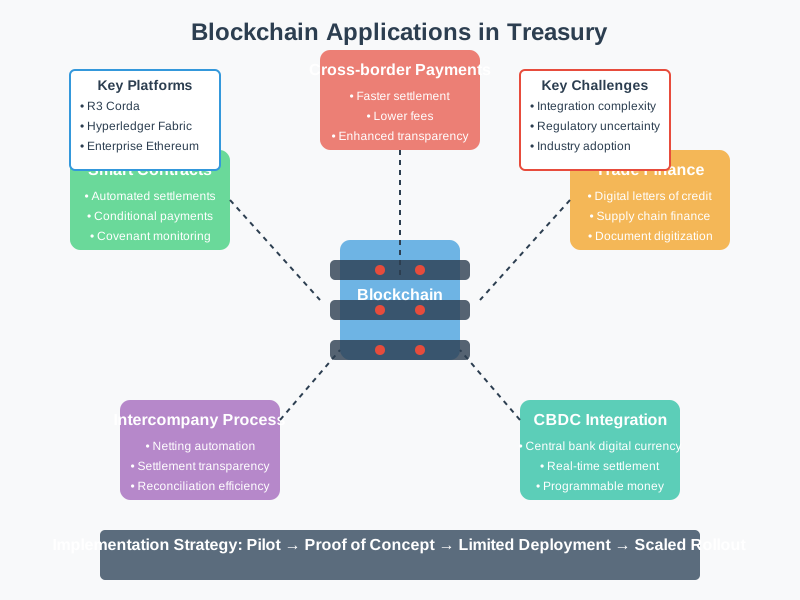
Blockchain applications in treasury: a central blockchain node connected to cross-border payments, trade finance, smart contracts, intercompany process automation, and CBDC integration, with key platforms (R3 Corda, Hyperledger Fabric, Enterprise Ethereum) and adoption challenges called out.

CSCF v2026: what changed

2.4 Back Office Data Flow Security

Securing data exchanges between secure zone and back-office systems — the biggest impact change for 2026.

Advisory → Mandatory
1.3 Containerization

Containers now explicitly in scope with refined isolation and segmentation guidance.

Clarified
4.2 Multi-Factor Authentication

MFA now required for external privileged firewall access and Alliance Security Officer accounts.

Expanded
6.1 Malware Protection

Coverage extended to non-Windows systems in secure zones (Linux, etc.).

Expanded
7.2 Security Awareness

Now references AI-related threats, including deepfake attacks.

Updated

Architecture Type B orgs may now need to attest as Type A4 if customer connectors are used. Alliance Connect VPN is in scope for multiple controls, and SWIFT's post-quantum cryptography roadmap is being formalised (KB article 5021566).
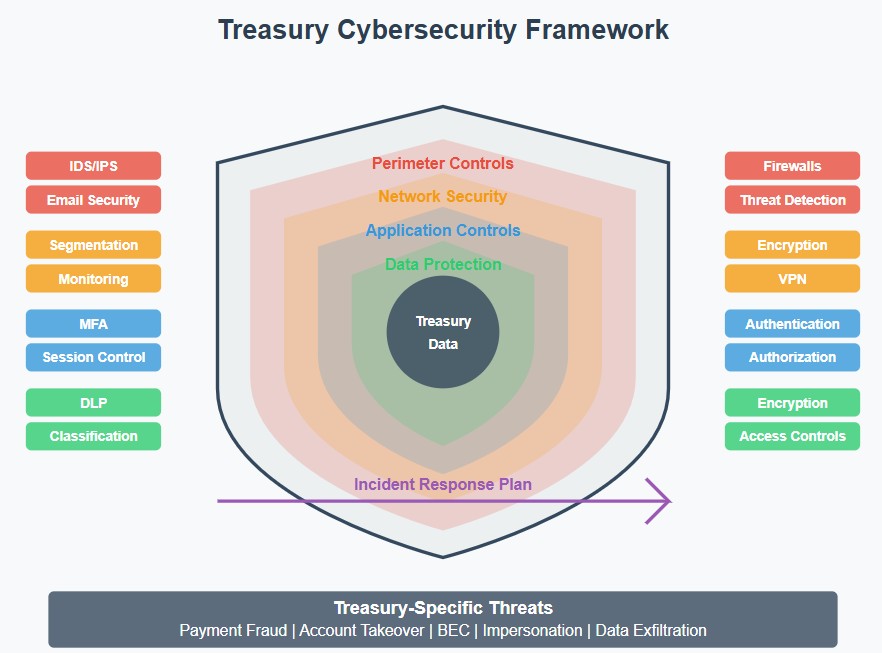
Treasury cybersecurity framework: layered perimeter controls, network security, application controls, and data protection around treasury data, with an incident response plan and treasury-specific threats (payment fraud, account takeover, BEC, impersonation, data exfiltration) called out below.

Corporate action plan: 2026 and beyond

Now
Address Compliance

Audit all party addresses in payment instructions. Clean master data to minimum city + ISO country ahead of the Nov 2026 mandate.

Q1–Q2
SCORE+ Evaluation

Assess cost/benefit of migrating FIN to FINplus. Evaluate partner bank SCORE+ readiness. Run a pilot with your primary bank.

Q2–Q3
ISO 20022 Cash Reporting

Adopt camt.052/053/054 for real-time and end-of-day statements. Configure ERP/TMS for structured data.

Q3–Q4
API & Instant Cash Reporting

Pilot SWIFT's multi-bank API gateway for instant balance/statement queries. Evaluate latency vs batch tradeoffs.

2027+
Digital Readiness

Monitor blockchain ledger development, assess tokenised deposit use cases, prepare for CBDC interop.

✓ Course complete

Key takeaways

SWIFT is no longer just a messaging network — it's evolving into a full-stack financial infrastructure with messaging + APIs + a blockchain ledger.

ISO 20022 is not optional. Coexistence is over — adopt SCORE+ and structured data proactively, not reactively.

GPI reset expectations: ~60% of cross-border payments credited under 30 minutes. Real-time tracking is the new baseline.

The blockchain ledger bridges TradFi and DeFi — tokenised deposits, stablecoins, and CBDCs on trusted, compliance-baked-in rails.

CSP 2026 expands mandatory controls. Back-office data flow security is no longer advisory, and post-quantum cryptography is on the horizon.

Sources: swift.com, JPMorgan ISO 20022, BIS CPMI, Sibos 2025 · treasuryease.com